Professional Gutters Services — Licensed CT Contractor
Gutters in Wallingford
Wallingford receives 47 inches of annual rainfall and 42 inches of snow, and the Quinnipiac River running through the center of town means that ground-level drainage is critical for the entire community, not just individual properties. The river creates an elevated water table throughout the valley floor neighborhoods — from Community Lake south through the Route 5 corridor — meaning that gutter overflow does not simply saturate surface soil and drain away. Instead, water pooling against foundations from overflowing gutters joins an already-elevated water table that pushes against basement walls through every wet season.
Homes along the river corridor face the compounding problem of gutter overflow adding to groundwater that is already at concerning levels during spring snowmelt and heavy summer rain. Properties on Cook Hill and the western slopes present the opposite challenge: steep lots channel runoff aggressively downhill, and improperly managed gutter discharge on uphill properties can create drainage problems for neighbors below. The post-war homes that dominate Wallingford's housing stock were built with four-inch galvanized steel gutters and round downspouts sized for 1950s rainfall patterns — Connecticut's increasingly intense summer thunderstorms, which regularly deliver an inch or more of rain within 30 minutes, overwhelm these undersized systems entirely.
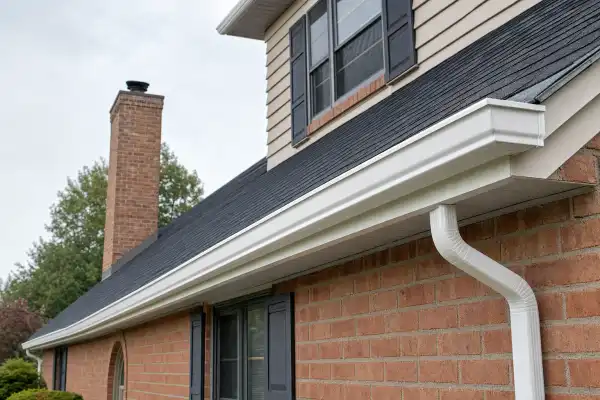
We install six-inch seamless aluminum gutters with oversized three-by-four-inch rectangular downspouts throughout Wallingford, with leaf protection systems matched to each property's specific tree canopy. Wallingford's mature oaks and maples in the established neighborhoods require robust gutter guard systems — micro-mesh for the small debris from oaks including acorn caps and catkins, surface-tension designs for the helicopter seeds and larger leaf litter from maples that dominate the Cook Hill corridor.
“After a burst pipe flooded our basement during a January freeze, Restoration Control arrived within an hour. Their team was professional, thorough, and kept us informed every step of the way. They handled our insurance claim and had our home restored in under two weeks. We could not have asked for a better experience.”
Robert & Linda M.
Hartford, CT
“A nor'easter ripped shingles off our Shippan Point home and water was pouring into the attic. Restoration Control had a crew on our roof the next morning, tarped the damage, and completed a full replacement within the week. Their knowledge of coastal roofing materials made all the difference.”
Jennifer S.
Stamford, CT
“We hired Restoration Control to replace the original siding on our 1920s Colonial in East Rock. They matched the historic character perfectly while upgrading to fiber cement that will actually withstand Connecticut winters. The craftsmanship is outstanding and the crew was respectful of our neighborhood.”
David & Maria T.
New Haven, CT
“After a kitchen fire, we were devastated. Restoration Control not only restored our home but helped us navigate the insurance process from start to finish. Their fire damage team removed all smoke odor and rebuilt our kitchen better than before. True professionals who treated us like family.”
Thomas K.
Bridgeport, CT
Frequently Asked Questions
Need Gutters in Wallingford?
Call now for a free estimate. Our Wallingford team responds within 60–90 minutes, 24 hours a day, 7 days a week.
Wallingford receives 47 inches of annual rainfall and 42 inches of snow, and the Quinnipiac River running through the center of town means that ground-level drainage is critical for the entire community, not just individual properties. The river creates an elevated water table throughout the valley floor neighborhoods — from Community Lake south through the Route 5 corridor — meaning that gutter overflow does not simply saturate surface soil and drain away. Instead, water pooling against foundations from overflowing gutters joins an already-elevated water table that pushes against basement walls through every wet season.
Homes along the river corridor face the compounding problem of gutter overflow adding to groundwater that is already at concerning levels during spring snowmelt and heavy summer rain. Properties on Cook Hill and the western slopes present the opposite challenge: steep lots channel runoff aggressively downhill, and improperly managed gutter discharge on uphill properties can create drainage problems for neighbors below. The post-war homes that dominate Wallingford's housing stock were built with four-inch galvanized steel gutters and round downspouts sized for 1950s rainfall patterns — Connecticut's increasingly intense summer thunderstorms, which regularly deliver an inch or more of rain within 30 minutes, overwhelm these undersized systems entirely.
We install six-inch seamless aluminum gutters with oversized three-by-four-inch rectangular downspouts throughout Wallingford, with leaf protection systems matched to each property's specific tree canopy. Wallingford's mature oaks and maples in the established neighborhoods require robust gutter guard systems — micro-mesh for the small debris from oaks including acorn caps and catkins, surface-tension designs for the helicopter seeds and larger leaf litter from maples that dominate the Cook Hill corridor.
Common Gutters Problems in Wallingford
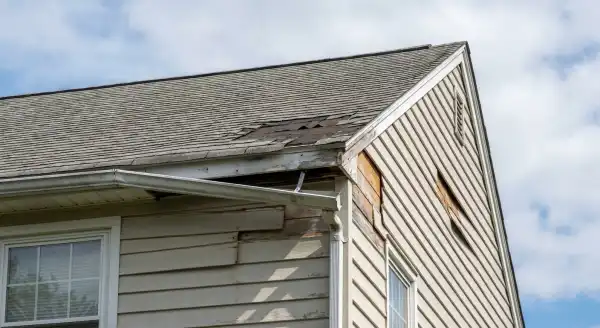
Wood rot at the fascia board — hidden behind the gutter face — is Wallingford's most frequent repair— and it is discovered only when the old gutters are removed for replacement. Even gutters that appear functional from the ground may have pulled away from the fascia by a fraction of an inch — enough for water to run behind the gutter during heavy rain and wick into the fascia board, rafter tails, and soffit framing. The Quinnipiac valley humidity slows drying in these concealed locations and accelerates rot — we find fascia damage requiring carpentry repair on more than half of Wallingford gutter replacements.
Ice loading during winter fills gutters with frozen water weighing 15 to 20 pounds per linear foot — original spike-and-ferrule hangers spaced every 32 inches cannot support this weight without pulling away from the fascia, creating gaps that allow water infiltration for the remainder of the winter. We install heavy-gauge hidden hangers on 16-inch centers that handle ice loads without deformation.
Underground drain failure in clay tile leaders from the 1950s is common throughout Wallingford's post-war neighborhoods — these original terra-cotta pipes have cracked, separated at joints, or been infiltrated by tree roots over 70 years. The symptom is often puzzling to homeowners: gutters that appear properly installed and drain effectively at the downspout still produce basement water problems because the underground connection is pooling water against the foundation below grade rather than carrying it to daylight or the storm sewer. We video-inspect underground leaders before connecting new gutter systems to verify that the underground drainage is functional.
Leaf clogging is severe in Wallingford's established neighborhoods where mature oaks, maples, and birches create a dense canopy that drops leaves, seeds, and small branches into unprotected gutters from October through December and again during spring pollen season. Without leaf protection, Wallingford gutters require cleaning four to six times annually — a maintenance burden and cost that a one-time guard installation eliminates.
Gutters Regulations in Wallingford, CT
Gutter replacement in Wallingford does not require a building permit, but downspout discharge must comply with town stormwater regulations — water cannot be directed onto neighboring properties, into swimming pools, or into the sanitary sewer system. Properties near the Quinnipiac River, Community Lake, or their tributaries are subject to Inland Wetlands Commission jurisdiction, and any ground disturbance for underground drain installation within the regulated area requires commission review and approval before work begins — a process that typically takes two to four weeks. Connecticut Home Improvement Contractor registration is required for all gutter work exceeding $200 in value. Historic properties along Main Street may require half-round gutter profiles rather than standard K-style to maintain architectural compatibility with colonial and Federal-era homes.
Gutters by Neighborhood in Wallingford
Cook Hill Road and Ward Street Extension have the highest-volume gutter demand in Wallingford — uniform undersized original systems on post-war capes and ranches all reaching replacement age within the same window, creating block-by-block upgrade patterns where one replacement prompts neighbors to schedule theirs. The Quinnipiac valley corridor needs the most robust drainage solutions in town — foundation water problems in this zone are often directly traceable to gutter overflow compounding already-elevated groundwater, and solving the gutter problem frequently resolves the basement problem that homeowners thought required expensive interior waterproofing.
Main Street's historic homes have complex gutter runs with multiple corners, miters, and return details that require custom fabrication — half-round copper or aluminum profiles on colonial homes, and K-style with decorative elements on Victorian properties. North Farms' larger colonials from the 1980s-1990s concentrate higher volumes of roof water at fewer downspout locations due to their larger roof areas, requiring carefully sized and graded ground-level drainage to manage the concentrated flow without erosion. Yalesville's mixed housing creates varied gutter scope depending on the building era and existing condition — 1940s farmhouses may still have original galvanized gutters while 1970s splits have first-generation aluminum in need of replacement.
Why Wallingford Needs Professional Gutters
Gutter failure in Wallingford cascades predictably into foundation damage that always costs more than the gutter replacement would have prevented. Overflowing gutters saturate soil against foundations, and Wallingford's Quinnipiac valley clay soil retains that moisture against concrete and block walls rather than draining it through permeable soil. The result is hydrostatic pressure against basement walls that pushes water through cracks, mortar joints, and the floor-wall seam — Wallingford's most common homeowner complaint during spring snowmelt and summer thunderstorms.
A properly sized six-inch gutter system with functional underground drainage eliminates the root cause of most Wallingford basement water problems at a fraction of the cost of interior waterproofing or French drain installation. For Cook Hill homeowners with 70-year-old homes, gutters are the highest-return exterior investment available — protecting fascia from rot, foundations from water intrusion, landscaping from erosion, and basements from flooding in one integrated system.
What's Included in Our Wallingford Gutters Service
Custom on-site fabrication of seamless gutters
Aluminum, copper, and steel gutter material options
Downspout extensions and underground drainage
Gutter guard and leaf protection systems
Hanger re-fastening and pitch correction
Fascia board inspection and repair if needed
Why Wallingford Homeowners Choose Restoration Control for Gutters
Licensed CT contractor — active state license verifiable online
IICRC-certified technicians with manufacturer-authorized installation training
Free on-site inspection and written estimate with no obligation in Wallingford
Full insurance claims support — documentation, Xactimate estimates, adjuster meetings
In-house crews only — no unlicensed subcontractors on your Wallingford project
Workmanship warranty backed by a company with 10+ years in Connecticut
24/7 emergency line for storm, water, and fire damage in Wallingford
BBB Accredited with A+ rating and 4.9-star average from 250+ reviews
What is the benefit of seamless gutters over sectional?
Seamless gutters are custom-fabricated on-site to your exact roofline measurements, eliminating the joints where sectional gutters most often leak. They require less maintenance and have a cleaner appearance. We form seamless gutters from .032-gauge aluminum in over 20 colors.
How often should gutters be cleaned?
In most climates, twice per year — once in late spring and once in late fall after leaves drop. Properties surrounded by pine trees may need cleaning 3-4 times per year. Gutter guards significantly reduce cleaning frequency but do not eliminate the need entirely.
Do gutter guards really work?
Quality micro-mesh gutter guards effectively block leaves, pine needles, and debris while allowing water to flow freely. They reduce cleaning frequency and protect your fascia and foundation. We install and warranty LeafFilter and similar micro-mesh systems.
Request Gutters in Wallingford, CT
Call (833) 380-7378 or complete the form below. A licensed CT estimator will contact you within 1 business hour to schedule your free on-site inspection.