Professional Fire Damage Services — Licensed CT Contractor
Fire Damage Restoration in Wallingford
Fire restoration in Wallingford addresses a housing stock where electrical system age creates concentrated risk in the post-war corridor that represents the town's largest residential segment. The thousands of capes and ranches built between 1950 and 1975 along Cook Hill Road, Ward Street Extension, and throughout the Route 5 corridor were wired with 60-amp electrical services — systems designed when the heaviest residential load was a refrigerator and a few incandescent light fixtures. These same circuits now carry central air conditioning, multiple televisions and computers, kitchen appliances including dishwashers and garbage disposals, and increasingly electric vehicle chargers — loads that the original wiring was never designed or rated to support.
Partial upgrades over the decades have addressed the most visible deficiency — many homes have had their original fuse boxes replaced with 100-amp breaker panels — but the branch circuit wiring running through walls and attic spaces remains the original cloth-insulated copper that becomes brittle and crack-prone after 50 to 70 years of service. Where these aging wires pass through framing members or are bent at junction boxes, the insulation cracks and exposes bare conductor that can arc against framing, initiate smoldering in wall cavities, and eventually produce fire.
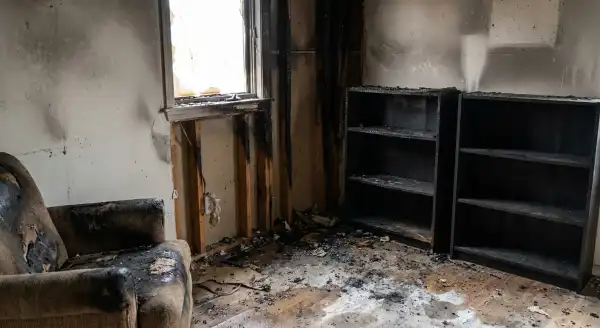
Kitchen fires from cooking accidents are the second most common fire category in Wallingford, typically originating as grease fires on cooking surfaces that extend to cabinetry, range hoods, and wall surfaces. While the fire itself may be contained to the kitchen within minutes, smoke migration through HVAC ductwork and wall cavities distributes soot and odor compounds throughout the entire home — making the restoration scope far larger than the visible fire damage suggests.
“After a burst pipe flooded our basement during a January freeze, Restoration Control arrived within an hour. Their team was professional, thorough, and kept us informed every step of the way. They handled our insurance claim and had our home restored in under two weeks. We could not have asked for a better experience.”
Robert & Linda M.
Hartford, CT
“A nor'easter ripped shingles off our Shippan Point home and water was pouring into the attic. Restoration Control had a crew on our roof the next morning, tarped the damage, and completed a full replacement within the week. Their knowledge of coastal roofing materials made all the difference.”
Jennifer S.
Stamford, CT
“We hired Restoration Control to replace the original siding on our 1920s Colonial in East Rock. They matched the historic character perfectly while upgrading to fiber cement that will actually withstand Connecticut winters. The craftsmanship is outstanding and the crew was respectful of our neighborhood.”
David & Maria T.
New Haven, CT
“After a kitchen fire, we were devastated. Restoration Control not only restored our home but helped us navigate the insurance process from start to finish. Their fire damage team removed all smoke odor and rebuilt our kitchen better than before. True professionals who treated us like family.”
Thomas K.
Bridgeport, CT
Frequently Asked Questions
Need Fire Damage in Wallingford?
Call now for a free estimate. Our Wallingford team responds within 60–90 minutes, 24 hours a day, 7 days a week.
Fire Damage Restoration in Wallingford, CT — Licensed Contractor
Fire restoration in Wallingford addresses a housing stock where electrical system age creates concentrated risk in the post-war corridor that represents the town's largest residential segment. The thousands of capes and ranches built between 1950 and 1975 along Cook Hill Road, Ward Street Extension, and throughout the Route 5 corridor were wired with 60-amp electrical services — systems designed when the heaviest residential load was a refrigerator and a few incandescent light fixtures. These same circuits now carry central air conditioning, multiple televisions and computers, kitchen appliances including dishwashers and garbage disposals, and increasingly electric vehicle chargers — loads that the original wiring was never designed or rated to support.
Partial upgrades over the decades have addressed the most visible deficiency — many homes have had their original fuse boxes replaced with 100-amp breaker panels — but the branch circuit wiring running through walls and attic spaces remains the original cloth-insulated copper that becomes brittle and crack-prone after 50 to 70 years of service. Where these aging wires pass through framing members or are bent at junction boxes, the insulation cracks and exposes bare conductor that can arc against framing, initiate smoldering in wall cavities, and eventually produce fire.
Kitchen fires from cooking accidents are the second most common fire category in Wallingford, typically originating as grease fires on cooking surfaces that extend to cabinetry, range hoods, and wall surfaces. While the fire itself may be contained to the kitchen within minutes, smoke migration through HVAC ductwork and wall cavities distributes soot and odor compounds throughout the entire home — making the restoration scope far larger than the visible fire damage suggests.
Common Fire Damage Restoration Problems in Wallingford
Smoke penetration through wall cavities and ductwork is the most persistent challenge in Wallingford fire restoration. Post-war homes with minimal insulation in wall cavities allow smoke to migrate freely through the entire wall assembly, depositing soot and odor compounds on every concealed surface — inside closet walls, above ceiling assemblies, within ductwork, behind built-in cabinetry, and inside wall cavities that are completely invisible without demolition. Standard surface cleaning addresses the visible soot on walls and ceilings but cannot reach these concealed deposits, which continue to release odor for months or years if not properly treated through thermal fogging or hydroxyl generation.
Electrical fire investigation in Wallingford homes consistently reveals that the wiring failure that caused the fire is not an isolated condition — the same age-related insulation degradation exists throughout the house wherever wire of the same vintage runs through heated attic spaces or passes through framing members. This means fire restoration in a Wallingford cape or ranch must include comprehensive electrical evaluation by a licensed electrician and often significant rewiring before any reconstruction work begins — an essential step that prevents recurrence but adds scope and cost that homeowners may not initially anticipate.
Suppression water damage from fire department operations adds a second major damage category that must be addressed simultaneously with the fire damage. Fire hose lines deliver water at volumes and pressures that saturate every material they contact, and the water that flows through the structure during fire suppression can cause as much dollar damage as the fire itself — soaked subfloors, saturated wall cavities, and standing water in basements require immediate extraction and structural drying to prevent mold colonization that would add a third damage category to the restoration scope.
Fire Damage Restoration Regulations in Wallingford, CT
Fire reconstruction in Wallingford requires building permits through the Building Department, and the scope of reconstruction must comply with current Connecticut Building Code — not the code in effect when the home was originally built. For a 1950s Cook Hill Road cape undergoing significant reconstruction after a fire, this typically means upgrading the electrical service to 200 amps, installing hard-wired interconnected smoke and carbon monoxide detectors on every floor and in every bedroom, and meeting current energy code insulation requirements in any wall or ceiling cavities that are opened during the repair process.
The Wallingford Fire Marshal must complete the fire investigation and release the property before any restoration work can begin — this process typically takes 24 to 72 hours for residential fires and may take longer if the cause is disputed or if accelerants are suspected. Connecticut HIC registration is required for all restoration contractors performing reconstruction work. Pre-1978 homes require lead paint testing before demolition of any fire-damaged materials — and virtually every original Cook Hill Road cape is a pre-1978 home. Asbestos testing is required for insulation, floor tiles, and joint compound in homes built before 1980 where these materials will be disturbed during reconstruction.
Fire Damage Restoration by Neighborhood in Wallingford
Cook Hill Road and Ward Street Extension generate Wallingford's highest volume of residential fire calls, with electrical fires in aging wiring and kitchen fires in original cooking areas being the most common scenarios. The predictable construction of these post-war homes — platform framing with 2x4 walls, hardwood or vinyl-asbestos tile flooring over plywood subfloor, plaster or early drywall wall surfaces — means our restoration teams can anticipate structural conditions and hidden damage patterns before opening walls, enabling more accurate scoping and more efficient restoration.
Main Street's historic colonial and Federal homes require preservation-grade fire restoration when damage occurs — plaster repair using traditional techniques, historic trim replication by skilled woodworkers, and period-appropriate hardware sourcing from specialty suppliers. The Route 5 corridor's mixed commercial-residential properties present complex fire scenarios where commercial occupancies adjacent to residential units can produce more intense fires with different smoke characteristics. North Farms' newer homes from the 1980s-1990s have generally better electrical systems with lower fire risk, but when fires do occur in these larger homes, the open floor plans allow smoke to spread rapidly throughout the structure, distributing soot and odor to every room.
Why Wallingford Needs Professional Fire Damage Restoration
Wallingford's fire risk concentrates in aging electrical infrastructure that does not fail dramatically — it fails incrementally, with overheated connections and deteriorating insulation creating smoldering conditions inside walls that may persist for hours before producing visible flame or triggering a smoke detector mounted on the opposite side of the wall. For homeowners in the Cook Hill corridor with original or minimally upgraded wiring, a comprehensive electrical evaluation — including thermal imaging of the panel and accessible wiring — is the fire prevention step that delivers the greatest risk reduction in Wallingford available.
When fire does occur, professional restoration is essential because fire damage is never limited to what is visible. Smoke penetrates every connected air space in the building envelope, and soot contains corrosive acidic compounds that continue to damage metal surfaces, discolor paint and finishes, and release odor for months if not properly neutralized through professional treatment. Insurance carriers require documented professional restoration to close fire claims, and attempting DIY fire cleanup typically results in persistent odor problems, ongoing surface deterioration, and denied claim portions that ultimately cost more than professional restoration would have.
What's Included in Our Wallingford Fire Damage Restoration Service
Emergency board-up and roof tarping within hours
Soot and smoke residue removal from all surfaces
Air scrubbing and ozone treatment for odor elimination
Content pack-out, cleaning, and storage
Structural repairs including framing, drywall, and flooring
Final sanitization, painting, and finish restoration
Why Wallingford Homeowners Choose Restoration Control for Fire Damage Restoration
Licensed CT contractor — active state license verifiable online
IICRC-certified technicians with manufacturer-authorized installation training
Free on-site inspection and written estimate with no obligation in Wallingford
Full insurance claims support — documentation, Xactimate estimates, adjuster meetings
In-house crews only — no unlicensed subcontractors on your Wallingford project
Workmanship warranty backed by a company with 10+ years in Connecticut
24/7 emergency line for storm, water, and fire damage in Wallingford
BBB Accredited with A+ rating and 4.9-star average from 250+ reviews
Do not re-enter until the fire marshal has cleared the property. Call your insurance company to report the claim, then call Restoration Control for emergency board-up and tarping to secure the structure. Do not attempt to clean soot or smoke residue yourself — improper cleaning can permanently set stains and embed odors.
Can smoke odor be completely removed?
Yes. We use a combination of HEPA air scrubbers, thermal foggers, hydroxyl generators, and ozone treatment to eliminate smoke odor at the molecular level. All porous materials (insulation, drywall, carpeting) that cannot be adequately cleaned are removed and replaced.
How long does fire damage restoration take?
Minor smoke damage cleanup may take 1-2 weeks. Significant structural fire damage requiring framing, drywall, flooring, and finish work can take 4-12 weeks. We provide a detailed restoration timeline after the initial assessment and coordinate directly with your insurance company throughout the project.
Request Fire Damage Restoration in Wallingford, CT
Call (833) 380-7378 or complete the form below. A licensed CT estimator will contact you within 1 business hour to schedule your free on-site inspection.