
Water damage is one of the most common and destructive emergencies Connecticut homeowners face. Whether it is a burst pipe during a January cold snap, a flooded basement from spring snowmelt, or a roof leak caused by a summer storm, what you do in the first 24 hours can mean the difference between a manageable repair and a catastrophic loss. According to the Insurance Information Institute, water damage and freezing account for nearly one in five homeowner insurance claims nationwide, and Connecticut's freeze-thaw climate makes the state particularly vulnerable.
This guide walks you through exactly what to do, hour by hour, when water damage strikes your Connecticut home.
Hour 0-1: Stop the Source and Stay Safe
Your first priority is safety. If standing water has reached electrical outlets, your breaker panel, or any appliances, do not walk through it. Shut off electricity at the main breaker if you can do so safely. If you smell gas or see structural damage, evacuate immediately and call 911.
Once it is safe, stop the water source. For a burst pipe, shut off the main water valve, which is typically in your basement near the water meter in most Connecticut homes built after 1950. For roof leaks, place buckets to collect water and move furniture away from the affected area. If the flooding is from an external source like a rising river or storm surge, there may be nothing you can do to stop it, so focus on protecting valuables and getting to safety.
Call a professional restoration company immediately. IICRC-certified technicians can begin water extraction within hours, which dramatically reduces secondary damage. In Connecticut, response time matters because our humid summers accelerate mold growth, and our cold winters mean standing water can cause pipes to re-freeze and burst again.
Hours 1-4: Document Everything
Before you move anything or start cleaning up, take thorough documentation for your insurance claim. Use your phone to photograph and video every affected area, including walls, floors, ceilings, and personal belongings. Connecticut follows an open perils standard on most HO-3 homeowner policies, which means water damage from sudden events like pipe bursts is generally covered, but your insurer will want proof of the damage and its cause.
Key documentation steps:
- Photograph the source of the water if visible (burst pipe, roof breach, appliance failure)
- Capture wide shots showing the full scope of flooding in each room
- Document water lines on walls that show the high-water mark
- Inventory damaged items with photos and estimated values
- Save receipts for any emergency expenses (hotel stays, emergency supplies, meals)
Contact your insurance company as soon as possible. Under Connecticut General Statutes Section 38a-307, insurers are required to acknowledge your claim within 15 business days and begin investigation within that time. However, filing early gives you a better position. Write down your claim number and the name of every person you speak with.
Hours 4-12: Water Extraction and Initial Drying
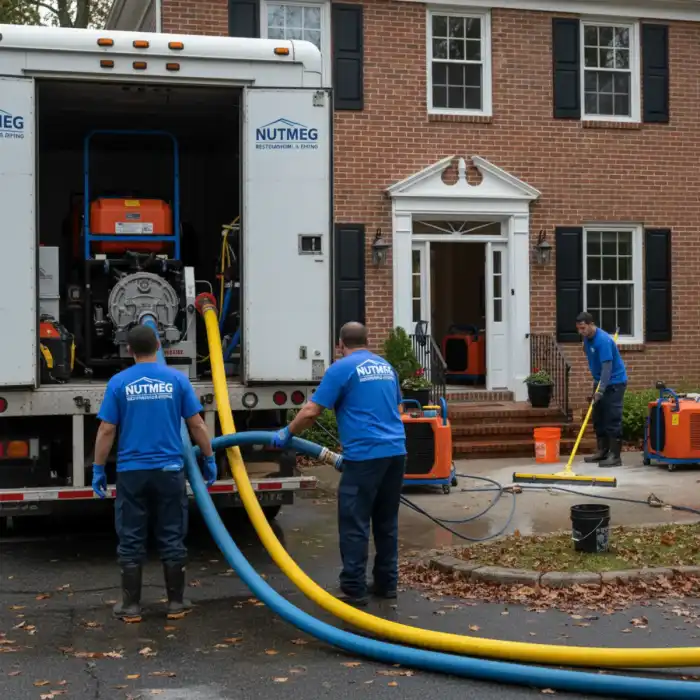
Professional water extraction is critical. Industrial pumps and truck-mounted extractors can remove hundreds of gallons per hour, far more than any shop vacuum. After extraction, restoration technicians set up commercial air movers and dehumidifiers. The goal is to bring moisture levels back below 15 percent in wood and below 1 percent in concrete, measured with professional-grade moisture meters.
While waiting for professionals, you can take these steps:
- Remove area rugs and small furniture from wet areas
- Lift curtains and drapes off wet floors
- Place aluminum foil under furniture legs to prevent staining on carpet
- Open cabinet doors and closets in affected areas to promote airflow
- Turn on your HVAC fan to circulate air if the system was not affected by water
Do not use a household vacuum to remove water. Do not use heat guns or space heaters to speed drying, as this can warp materials and create fire hazards. Do not remove baseboards or drywall yourself unless you have confirmed there is no asbestos, which is common in Connecticut homes built before 1980.
Hours 12-24: Mold Prevention Is Now the Priority
In Connecticut's climate, mold can begin colonizing damp materials in as little as 24 to 48 hours. During summer months when relative humidity regularly exceeds 70 percent, that timeline can compress to under 24 hours. Connecticut does not have state-specific mold remediation statutes like some states, but the Connecticut Department of Public Health recommends following EPA guidelines, which call for professional remediation when mold covers more than 10 square feet.
By the 12-hour mark, your restoration team should have moisture mapping completed, which is a detailed room-by-room assessment of where moisture has traveled. Water wicks up drywall at roughly one inch per hour, which means a 12-hour exposure could mean moisture 12 inches up your walls, even if the standing water was only an inch deep on the floor.
Antimicrobial treatments should be applied to all affected surfaces within the first 24 hours. This is not a DIY bleach job. Professional antimicrobials penetrate porous materials and provide residual protection that household cleaners cannot match.
What Not to Do in the First 24 Hours
Avoid these common mistakes that Connecticut homeowners make after water damage:
- Do not wait to call for help. Every hour of delay increases damage exponentially
- Do not throw away damaged items before your insurance adjuster has seen them or you have photographic documentation
- Do not enter rooms with sagging ceilings. Water-soaked drywall is extremely heavy and can collapse without warning
- Do not turn on ceiling fans if the ceiling is wet, as the electrical box may be compromised
- Do not assume the water is clean. Category 1 clean water can become Category 2 gray water within 48 hours as bacteria multiply
Connecticut-Specific Considerations
Connecticut's building codes, governed by the State Building Code (Connecticut General Statutes Section 29-252), require that any water-damaged structural components be dried or replaced to meet original building standards. If your home has a finished basement, which is common throughout Hartford County, New Haven County, and Fairfield County, be aware that building codes require GFCI outlets within six feet of any water source. After flooding, these outlets and their wiring must be inspected by a licensed electrician before the power is restored.
For homes in flood-prone areas along the Connecticut River, the Housatonic River, or the Long Island Sound coastline, check whether you are in a FEMA-designated flood zone. Standard homeowner policies do not cover flood damage, and you may need to file a separate claim through the National Flood Insurance Program.
Get Help Now
Water damage does not wait, and neither should you. Restoration Control provides 24/7 emergency water damage response across Connecticut, with typical arrival times of 60 to 90 minutes. Our IICRC-certified technicians handle everything from initial extraction to complete structural drying and mold prevention. We work directly with your insurance company to streamline the claims process. Call us now at (833) 380-7378 for immediate assistance.