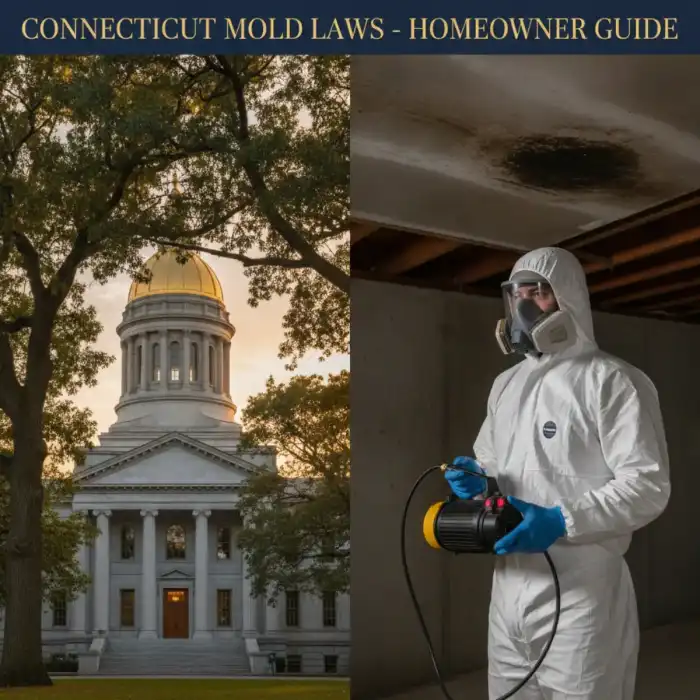
Mold is one of the most misunderstood hazards in Connecticut homes. Unlike asbestos or lead paint, which have clear federal and state regulations, mold exists in a complicated legal gray area. Connecticut does not have a standalone mold statute, but that does not mean homeowners are without protections. A patchwork of public health codes, landlord-tenant laws, real estate disclosure requirements, and building codes create a framework that every Connecticut homeowner and buyer should understand.
This guide breaks down what the law actually says, what your rights are, and what steps to take if you discover mold in your home.
Connecticut Does Not Have a Specific Mold Law, But You Are Still Protected
As of 2026, Connecticut has no state-level statute specifically regulating mold in residential properties. There is no state-mandated acceptable mold level, no required mold testing protocol, and no state licensing requirement for mold remediation companies. This puts Connecticut in the same category as most states, as the EPA has consistently declined to set federal mold standards.
However, several existing Connecticut laws provide indirect but meaningful protections:
- Connecticut General Statutes Section 47a-7 requires landlords to maintain rental properties in a condition that is fit for human habitation. Courts have consistently interpreted this to include addressing mold that poses health risks. If you are a renter and your landlord refuses to address mold, you have legal standing to request remediation or, in severe cases, to withhold rent through the proper legal channels.
- The Connecticut Uniform Property Condition Disclosure Act (Section 20-327b) requires sellers to disclose known material defects, including known mold issues, on the property condition disclosure report. Failing to disclose known mold is grounds for legal action after the sale.
- Connecticut Public Health Code Section 19-13-B1 gives local health directors the authority to order remediation of conditions that create a health hazard, which can include extensive mold contamination.
Your Rights as a Connecticut Homeowner
Even without a dedicated mold statute, Connecticut homeowners have several avenues for protection and recourse:
Insurance coverage. Most Connecticut homeowner policies cover mold remediation if the mold resulted from a covered peril. For example, if a burst pipe causes water damage and mold develops, the mold remediation is typically covered as part of the water damage claim. However, mold resulting from long-term neglect, deferred maintenance, or gradual leaks is almost never covered. Check your policy for specific mold coverage limits, as many carriers in Connecticut cap mold coverage at $5,000 to $10,000 unless you purchase additional coverage.
Local health department intervention. If mold in your home or a neighboring property becomes a health hazard, you can contact your local health department. In Connecticut, local health directors have broad authority under CGS Section 19a-206 to investigate and order remediation of environmental health hazards. Towns like Hartford, New Haven, Stamford, and Bridgeport have active environmental health divisions that respond to mold complaints.
Building code requirements. The Connecticut State Building Code, which follows the International Residential Code, requires adequate ventilation in all habitable spaces. If your home was built or renovated without proper ventilation, such as a bathroom without an exhaust fan or an attic without soffit vents, that code violation may create liability for the builder or contractor if mold develops as a result.
Mold Disclosure When Selling Your Connecticut Home
Connecticut law is clear about disclosure obligations. Under Section 20-327b, sellers must complete a property condition disclosure form that includes questions about known water damage, flooding, and environmental hazards. While the form does not have a specific checkbox for mold, the broad category of environmental hazards and the general duty to disclose known material defects covers mold.
If you have had mold remediation performed, you should disclose it along with documentation showing the remediation was completed by qualified professionals. Counterintuitively, a documented remediation actually increases buyer confidence because it shows the problem was identified and properly addressed, as opposed to homes where mold may exist but has never been tested for.
Buyers should note: Connecticut is a caveat emptor state for conditions that are reasonably discoverable during inspection. This means you cannot sue a seller for mold that a standard home inspection should have detected. Always hire an inspector who includes moisture meter readings and visual mold assessment as part of their standard inspection protocol.
When to Call a Professional
The EPA's guideline is straightforward: if mold covers more than 10 square feet, roughly a 3-by-3-foot area, you should hire a professional remediation company. For Connecticut homes, we recommend being more conservative than the EPA guideline because our humid climate means mold can spread rapidly, especially between June and September when average relative humidity exceeds 70 percent.
Signs that professional remediation is necessary:
- Visible mold growth covering more than a few square feet
- Musty odors even when no mold is visible, which often indicates mold inside walls, above ceiling tiles, or under flooring
- Recurring mold in the same location after cleaning, which indicates a moisture source that has not been resolved
- Mold discovered during renovation behind walls, under flooring, or in ductwork
- Any mold exposure causing health symptoms in household members, especially respiratory issues, persistent headaches, or allergic reactions
Choosing a Mold Remediation Company in Connecticut
Because Connecticut does not license mold remediation companies at the state level, the burden falls on homeowners to vet their contractor carefully. Look for the following:
- IICRC certification in Applied Microbial Remediation (AMRT), which is the industry standard
- General liability insurance and workers compensation coverage
- Written remediation protocol that follows IICRC S520 standards
- Third-party post-remediation verification, meaning an independent company confirms the mold was successfully removed, not just the company that did the work
- Connecticut contractor registration through the Department of Consumer Protection, which is required for any home improvement work exceeding $200
Preventing Mold in Connecticut Homes
Prevention is always more effective and far less expensive than remediation. Connecticut's climate creates four distinct mold risk seasons:
- Winter: Condensation on cold surfaces, ice dams causing roof leaks, frozen pipes bursting
- Spring: Snowmelt flooding basements, rising water tables, spring rain on compromised roofs
- Summer: High humidity feeding mold growth, air conditioning condensation issues, attic heat trapping moisture
- Fall: Nor'easters bringing wind-driven rain, leaf-clogged gutters causing water backup, temperature swings creating condensation
Maintain indoor humidity between 30 and 50 percent year-round, ensure your bathroom and kitchen exhaust fans vent to the exterior and not into the attic, grade soil away from your foundation at a minimum slope of six inches over ten feet, and inspect your roof and gutters twice per year.
Need Help With Mold in Your Connecticut Home?
Restoration Control provides comprehensive mold inspection and remediation services across Connecticut. Our IICRC-certified technicians follow S520 remediation standards and use third-party verification testing to ensure the job is done right. We work directly with your insurance company to maximize your claim coverage. Call (833) 380-7378 for a free mold assessment, or visit our mold remediation page for more information.