Professional Fire Damage Services — Licensed CT Contractor
Fire Damage Restoration in Hartford
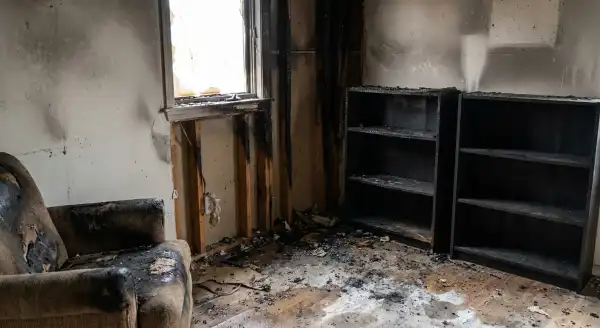
Fire damage restoration in Hartford requires understanding both the city's building stock and the secondary damage that Connecticut's climate inflicts after the flames are out. Hartford's pre-war multi-family buildings — concentrated in Frog Hollow, Barry Square, Clay Arsenal, and Asylum Hill — were built with balloon-frame construction where continuous wall cavities allow fire to spread rapidly from basement to attic, often producing total-loss conditions in the fire unit and heavy smoke damage throughout the building. After fire department suppression, thousands of gallons of water saturate the structure, and Hartford's cold winters mean this water freezes inside walls, expanding and cracking plaster, splitting wood framing, and causing secondary structural damage that may exceed the fire damage itself. Our Hartford fire restoration teams begin with structural assessment and emergency board-up within hours of fire department clearance, then deploy commercial dehumidification to prevent the freeze-damage cycle in winter and mold establishment in warmer months. Hartford's housing density means fire damage rarely affects a single unit — smoke travels through shared HVAC systems, common walls, and open stairwells to contaminate adjacent apartments, requiring building-wide assessment even when visible fire damage is contained.
“After a burst pipe flooded our basement during a January freeze, Restoration Control arrived within an hour. Their team was professional, thorough, and kept us informed every step of the way. They handled our insurance claim and had our home restored in under two weeks. We could not have asked for a better experience.”
Robert & Linda M.
Hartford, CT
“A nor'easter ripped shingles off our Shippan Point home and water was pouring into the attic. Restoration Control had a crew on our roof the next morning, tarped the damage, and completed a full replacement within the week. Their knowledge of coastal roofing materials made all the difference.”
Jennifer S.
Stamford, CT
“We hired Restoration Control to replace the original siding on our 1920s Colonial in East Rock. They matched the historic character perfectly while upgrading to fiber cement that will actually withstand Connecticut winters. The craftsmanship is outstanding and the crew was respectful of our neighborhood.”
David & Maria T.
New Haven, CT
“After a kitchen fire, we were devastated. Restoration Control not only restored our home but helped us navigate the insurance process from start to finish. Their fire damage team removed all smoke odor and rebuilt our kitchen better than before. True professionals who treated us like family.”
Thomas K.
Bridgeport, CT
Frequently Asked Questions
Need Fire Damage in Hartford?
Call now for a free estimate. Our Hartford team responds within 60–90 minutes, 24 hours a day, 7 days a week.
Fire Damage Restoration in Hartford, CT — Licensed Contractor
Fire damage restoration in Hartford requires understanding both the city's building stock and the secondary damage that Connecticut's climate inflicts after the flames are out. Hartford's pre-war multi-family buildings — concentrated in Frog Hollow, Barry Square, Clay Arsenal, and Asylum Hill — were built with balloon-frame construction where continuous wall cavities allow fire to spread rapidly from basement to attic, often producing total-loss conditions in the fire unit and heavy smoke damage throughout the building. After fire department suppression, thousands of gallons of water saturate the structure, and Hartford's cold winters mean this water freezes inside walls, expanding and cracking plaster, splitting wood framing, and causing secondary structural damage that may exceed the fire damage itself. Our Hartford fire restoration teams begin with structural assessment and emergency board-up within hours of fire department clearance, then deploy commercial dehumidification to prevent the freeze-damage cycle in winter and mold establishment in warmer months. Hartford's housing density means fire damage rarely affects a single unit — smoke travels through shared HVAC systems, common walls, and open stairwells to contaminate adjacent apartments, requiring building-wide assessment even when visible fire damage is contained.
Common Fire Damage Restoration Problems in Hartford
Balloon-frame fire spread is Hartford's most dangerous structural fire pattern. In pre-1940 multi-family buildings, wall cavities run continuously from the foundation sill to the attic rafters with no fire blocking — flames entering a first-floor wall cavity can reach the attic in minutes. This construction type dominates Frog Hollow, Barry Square, and Clay Arsenal. Electrical fires from overloaded systems are a leading cause in Hartford's older housing — original 60-amp knob-and-tube wiring cannot support modern electrical loads, and tenant-added space heaters during Hartford's cold winters create circuit overloads that ignite within wall cavities where detection is delayed. Smoke migration through HVAC ductwork is the most common secondary damage pattern — smoke particulate coats every interior surface connected to the duct system, requiring professional cleaning of ductwork, walls, ceilings, textiles, and contents throughout the building. Cooking fires are the most frequent fire type in Hartford but typically produce the least structural damage — hood and cabinet replacement, smoke cleaning, and odor treatment. Suppression water damage in multi-story Hartford buildings creates the most complex restoration scope — water flows downward through floor assemblies for hours after suppression, saturating every level below the fire floor.
Fire Damage Restoration Regulations in Hartford, CT
Fire reconstruction in Hartford requires permits for all structural, electrical, plumbing, and mechanical work through the Department of Development Services. All rebuilt systems must meet current Connecticut Building Code, which typically means significant upgrades over what existed — modern smoke and CO detector requirements (interconnected, in every bedroom and common area), updated electrical service (200-amp minimum for single-family), fire separation between dwelling units to current fire-resistance ratings, and hardwired fire alarm systems in buildings with three or more units. Properties in the West End or Sigourney Square Historic Districts require Historic Preservation Commission review for any exterior reconstruction that changes appearance — replacement windows, siding materials, and architectural details must be compatible with the historic character. Hartford's fire marshal's office conducts origin-and-cause investigation and must clear the structure before restoration work begins. Insurance documentation coordination between the property owner, insurance adjuster, and restoration contractor should begin within 24 hours of the fire. Connecticut requires CT HIC registration for all reconstruction work. Demolition permits are required separately if structural removal is part of the restoration scope. Asbestos and lead testing are mandatory before any demolition or disturbance in pre-1978 construction.
Fire Damage Restoration by Neighborhood in Hartford
Frog Hollow has Hartford's highest fire incident rate, reflecting dense multi-family housing with aging electrical systems, balloon-frame construction, and high occupancy. Restoration in Frog Hollow typically involves multi-unit buildings where fire in one apartment causes smoke and water damage throughout the structure — full building assessment is standard protocol. Barry Square's triple-decker buildings present a specific vertical fire challenge: three stacked residential units with shared wall cavities mean a basement electrical fire can involve all three floors before suppression arrives. Clay Arsenal, north of downtown, has a mix of Victorian-era wood-frame homes and early 20th-century multi-family buildings with some of Hartford's most outdated electrical systems — knob-and-tube wiring still present in homes that have never been fully updated. Asylum Hill's larger apartment buildings have more modern fire protection but present different restoration challenges: commercial-scale smoke cleaning, multi-floor water damage from sprinkler activation, and tenant relocation coordination for dozens of units. West End fire restoration requires the most sensitive approach — historic homes with irreplaceable architectural details like original woodwork, built-in cabinetry, and decorative plaster that must be preserved during cleaning and reconstruction. Behind the Rocks and South End fires are typically single-family incidents with more contained damage and faster restoration timelines — four to eight weeks compared to three to six months for multi-family Frog Hollow or Barry Square projects.
Why Hartford Needs Professional Fire Damage Restoration
Hartford's fire risk is elevated by three converging factors: aging electrical systems in housing built before modern loads were contemplated, heating-season stress from Connecticut's cold winters, and dense multi-family construction where fire spreads rapidly and affects many households simultaneously. The Hartford Fire Department responds to hundreds of structure fires annually, and the secondary damage from suppression water and Connecticut's freeze-thaw climate means professional restoration is essential — amateur cleanup of smoke damage embeds particulate in porous materials, creating permanent odor and potential health effects. The economic stakes for Hartford property owners are significant: fire damage claims average substantially more than other property claims, and proper restoration documentation directly affects insurance settlement amounts. For Hartford's multi-family property owners, rapid professional restoration minimizes tenant displacement and lost rental income — having a restoration contractor on call before an emergency means the difference between weeks and months of vacancy. Electrical inspection and panel upgrade is the fire safety measure with the highest return for Hartford homeowners in Hartford's older housing stock — converting from 60-amp to 200-amp service with arc-fault circuit interrupter (AFCI) protection addresses the root cause of the majority of Hartford's electrical fires.
What's Included in Our Hartford Fire Damage Restoration Service
Emergency board-up and roof tarping within hours
Soot and smoke residue removal from all surfaces
Air scrubbing and ozone treatment for odor elimination
Content pack-out, cleaning, and storage
Structural repairs including framing, drywall, and flooring
Final sanitization, painting, and finish restoration
Why Hartford Homeowners Choose Restoration Control for Fire Damage Restoration
Licensed CT contractor — active state license verifiable online
IICRC-certified technicians with manufacturer-authorized installation training
Free on-site inspection and written estimate with no obligation in Hartford
Full insurance claims support — documentation, Xactimate estimates, adjuster meetings
In-house crews only — no unlicensed subcontractors on your Hartford project
Workmanship warranty backed by a company with 10+ years in Connecticut
24/7 emergency line for storm, water, and fire damage in Hartford
BBB Accredited with A+ rating and 4.9-star average from 250+ reviews
Do not re-enter until the fire marshal has cleared the property. Call your insurance company to report the claim, then call Restoration Control for emergency board-up and tarping to secure the structure. Do not attempt to clean soot or smoke residue yourself — improper cleaning can permanently set stains and embed odors.
Can smoke odor be completely removed?
Yes. We use a combination of HEPA air scrubbers, thermal foggers, hydroxyl generators, and ozone treatment to eliminate smoke odor at the molecular level. All porous materials (insulation, drywall, carpeting) that cannot be adequately cleaned are removed and replaced.
How long does fire damage restoration take?
Minor smoke damage cleanup may take 1-2 weeks. Significant structural fire damage requiring framing, drywall, flooring, and finish work can take 4-12 weeks. We provide a detailed restoration timeline after the initial assessment and coordinate directly with your insurance company throughout the project.
Request Fire Damage Restoration in Hartford, CT
Call (833) 380-7378 or complete the form below. A licensed CT estimator will contact you within 1 business hour to schedule your free on-site inspection.