Professional Bathroom Remodeling Services — Licensed CT Contractor
Bathroom Remodeling in Hartford
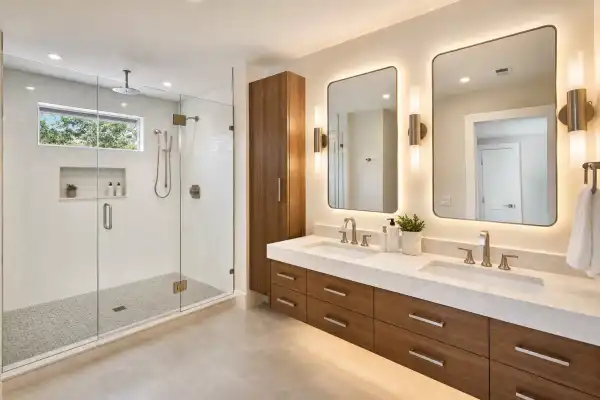
Bathroom remodeling in Hartford addresses the most moisture-vulnerable room in homes where the original builders had no concept of modern waterproofing. In West End Victorians and Asylum Hill multi-family buildings, original bathrooms from the 1890s to 1920s have cast-iron drain pipes over 100 years old, tile set directly on plaster walls with no waterproof membrane, and either no mechanical ventilation or a passive vent that provides negligible moisture removal. Connecticut's humid summers — dew points regularly above 65 degrees from June through September — mean that inadequately ventilated Hartford bathrooms remain damp for hours after use, promoting mold growth in wall cavities, ceiling assemblies, and subfloor layers that aren't visible until renovation exposes them. Our Hartford bathroom renovations follow a moisture-first protocol: every project begins with complete demolition to framing, inspection and remediation of any mold or rot discovered, installation of a continuous waterproof membrane system (Kerdi or equivalent) on all wet walls and floors, and properly ducted mechanical exhaust ventilation sized to the room volume. Only after the moisture envelope is established do we proceed with finish tile, fixtures, and trim. This approach costs more upfront than a surface-level renovation but eliminates the hidden moisture damage that compromises Hartford's bathroom structures within years of a cosmetic-only update.
“After a burst pipe flooded our basement during a January freeze, Restoration Control arrived within an hour. Their team was professional, thorough, and kept us informed every step of the way. They handled our insurance claim and had our home restored in under two weeks. We could not have asked for a better experience.”
Robert & Linda M.
Hartford, CT
“A nor'easter ripped shingles off our Shippan Point home and water was pouring into the attic. Restoration Control had a crew on our roof the next morning, tarped the damage, and completed a full replacement within the week. Their knowledge of coastal roofing materials made all the difference.”
Jennifer S.
Stamford, CT
“We hired Restoration Control to replace the original siding on our 1920s Colonial in East Rock. They matched the historic character perfectly while upgrading to fiber cement that will actually withstand Connecticut winters. The craftsmanship is outstanding and the crew was respectful of our neighborhood.”
David & Maria T.
New Haven, CT
“After a kitchen fire, we were devastated. Restoration Control not only restored our home but helped us navigate the insurance process from start to finish. Their fire damage team removed all smoke odor and rebuilt our kitchen better than before. True professionals who treated us like family.”
Thomas K.
Bridgeport, CT
Frequently Asked Questions
Need Bathroom Remodeling in Hartford?
Call now for a free estimate. Our Hartford team responds within 60–90 minutes, 24 hours a day, 7 days a week.
Bathroom Remodeling in Hartford, CT — Licensed Contractor
Bathroom remodeling in Hartford addresses the most moisture-vulnerable room in homes where the original builders had no concept of modern waterproofing. In West End Victorians and Asylum Hill multi-family buildings, original bathrooms from the 1890s to 1920s have cast-iron drain pipes over 100 years old, tile set directly on plaster walls with no waterproof membrane, and either no mechanical ventilation or a passive vent that provides negligible moisture removal. Connecticut's humid summers — dew points regularly above 65 degrees from June through September — mean that inadequately ventilated Hartford bathrooms remain damp for hours after use, promoting mold growth in wall cavities, ceiling assemblies, and subfloor layers that aren't visible until renovation exposes them. Our Hartford bathroom renovations follow a moisture-first protocol: every project begins with complete demolition to framing, inspection and remediation of any mold or rot discovered, installation of a continuous waterproof membrane system (Kerdi or equivalent) on all wet walls and floors, and properly ducted mechanical exhaust ventilation sized to the room volume. Only after the moisture envelope is established do we proceed with finish tile, fixtures, and trim. This approach costs more upfront than a surface-level renovation but eliminates the hidden moisture damage that compromises Hartford's bathroom structures within years of a cosmetic-only update.
Common Bathroom Remodeling Problems in Hartford
Cast-iron drain failure is Hartford's most critical bathroom infrastructure issue. Original cast-iron waste and vent pipes from the early 1900s have corroded internally for over a century — reduced flow capacity causes slow drains that homeowners attribute to clogs, but the real problem is pipe walls roughened and narrowed by corrosion, catching debris and backing up. We scope drain lines with camera inspection on every Hartford bathroom renovation and find significant deterioration on virtually every pre-1950 cast-iron system. Complete replacement with PVC from the bathroom to the main stack is standard scope. Absent waterproofing behind tile is the second universal condition: every original Hartford bathroom we have demolished — without exception — has tile set on plaster or drywall with no waterproof membrane. Every shower use has been sending moisture into the wall framing for decades. The resulting conditions range from cosmetic (stained or soft drywall in adjacent rooms) to structural (subfloor delamination requiring joist sistering). Inadequate ventilation compounds the waterproofing problem: many Hartford bathrooms have no exhaust fan, a fan vented into the attic rather than to the exterior, or a fan so undersized it moves negligible air volume. Toilet flange area subfloor damage shows up in about 60 percent of the Hartford bathrooms we demolish— slow wax ring failure seeps water into the subfloor for years before any visible indication appears.
Bathroom Remodeling Regulations in Hartford, CT
Bathroom remodeling in Hartford requires plumbing and electrical permits filed through the Department of Development Services. Connecticut plumbing code requires proper venting for all drain fixtures, water supply with anti-scald mixing valves (maximum 120°F at the fixture), and accessible shut-offs. Electrical code requires GFCI protection on all bathroom receptacles, a dedicated 20-amp circuit for the bathroom, and hardwired mechanical exhaust ventilation with a minimum capacity of 50 CFM ducted to the building exterior — not into an attic, soffit, or wall cavity. The exhaust duct must terminate with a proper exterior cap with backdraft damper. For bathrooms over 100 square feet, required CFM increases proportionally. Plumbing permits cover all drain, water supply, and fixture changes. Structural permits apply if floor framing modification is needed for subfloor replacement or tub-to-shower conversion that changes floor load distribution. Lead paint testing is required before demolition in pre-1978 homes — Hartford's housing age means this applies to the vast majority of bathroom projects. Asbestos-containing materials are common in Hartford bathrooms: floor tile, pipe insulation, and some plaster compounds must be tested before disturbance. Historic district properties require review for any exterior changes — typically exhaust vent placement on street-facing elevations. CT HIC registration mandatory for all contractors.
Bathroom Remodeling by Neighborhood in Hartford
West End bathrooms present Hartford's most complex renovation scope — Victorian homes with original 1890s-1920s plumbing routing through thick plaster walls, ornamental tile floors that homeowners may want preserved, and clawfoot tub installations on upper floors where subfloor condition must be carefully assessed before any fixture change. Ceiling heights of nine to ten feet create unique ventilation challenges requiring longer duct runs. Asylum Hill's multi-family buildings have shared plumbing stacks that constrain drain relocation — bathroom renovations must work within the existing stack location or involve costly stack modification that affects all connected units. Barry Square and Frog Hollow triple-deckers present the same shared-stack constraint with the added complexity of three vertically stacked bathrooms where renovation of one unit should consider the condition of the shared waste system. Clay Arsenal's pre-war housing has some of Hartford's most deteriorated bathroom infrastructure — deferred maintenance means renovation scope frequently expands from the planned bathroom to adjacent hallway and bedroom subfloors where undetected moisture has traveled. Behind the Rocks' ranch homes have slab-on-grade bathrooms where drain replacement requires concrete cutting and reconfiguration — a specialized scope that adds cost but enables complete plumbing replacement. Parkville colonials have second-floor bathrooms with accessible subfloor and plumbing from the basement, making them Hartford's most efficient renovation scope for the quality of result. South End cape cods often have a single bathroom that must remain partially functional during renovation, requiring careful phasing.
Why Hartford Needs Professional Bathroom Remodeling
Bathroom renovation urgency in Hartford is driven by concealed moisture damage that worsens with every use of a bathroom that lacks modern waterproofing. Every shower taken in an un-membraned Hartford bathroom — and that includes virtually every original bathroom in the city — sends moisture into wall framing, subfloor, and ceiling assemblies below. The damage is cumulative and invisible until it becomes structural. Hartford's climate amplifies the problem: summer humidity prevents drying, winter condensation adds moisture load, and the annual cycle accelerates mold establishment and wood decay. Cast-iron drain replacement is time-sensitive in a different way — corroded pipes don't fail gradually, they develop pinholes and cracks that leak sewage into floor assemblies, creating Category 3 contamination that requires extensive remediation. The health dimension is significant: mold behind bathroom walls produces airborne spores that affect respiratory health, particularly in children and the elderly. In Hartford's rental housing market, bathrooms with visible mold, poor ventilation, and plumbing problems are habitability issues that can trigger code enforcement. For homeowners, bathroom condition is second only to kitchen in its impact on Hartford home values — a properly renovated bathroom with modern waterproofing, ventilation, and fixtures is the most reliable return-on-investment renovation in the Hartford market.
What's Included in Our Hartford Bathroom Remodeling Service
Walk-in shower builds with custom tile and glass enclosures
Tub-to-shower and shower-to-tub conversions
Vanity, mirror, and medicine cabinet installation
Toilet replacement and plumbing upgrades
Heated floor tile and exhaust fan upgrades
Waterproofing membrane installation in wet areas
Why Hartford Homeowners Choose Restoration Control for Bathroom Remodeling
Licensed CT contractor — active state license verifiable online
IICRC-certified technicians with manufacturer-authorized installation training
Free on-site inspection and written estimate with no obligation in Hartford
Full insurance claims support — documentation, Xactimate estimates, adjuster meetings
In-house crews only — no unlicensed subcontractors on your Hartford project
Workmanship warranty backed by a company with 10+ years in Connecticut
24/7 emergency line for storm, water, and fire damage in Hartford
BBB Accredited with A+ rating and 4.9-star average from 250+ reviews
A standard bathroom update (new vanity, toilet, tub surround, and fixtures) ranges from $5,000 to $12,000. A full custom walk-in shower conversion with tile, glass, and plumbing work ranges from $8,000 to $20,000+. We provide detailed written estimates before any work begins.
How do you waterproof a shower?
We use a multi-layer waterproofing system including a pre-sloped shower pan, Schluter KERDI or RedGard membrane applied to all walls and curbs, followed by properly spaced and back-buttered tile with unsanded grout on walls and sanded grout on floors. All penetrations are caulked with 100% silicone.
Can you convert a tub to a walk-in shower?
Yes, tub-to-shower conversions are one of our most popular projects. We remove the existing tub, re-frame the alcove, install a custom shower pan and tile walls, add a frameless or framed glass enclosure, and upgrade the valve, showerhead, and fixtures. The project typically takes 5-7 days.
Request Bathroom Remodeling in Hartford, CT
Call (833) 380-7378 or complete the form below. A licensed CT estimator will contact you within 1 business hour to schedule your free on-site inspection.