Professional Bathroom Remodeling Services — Licensed CT Contractor
Bathroom Remodeling in Middletown
Bathroom remodeling in Middletown uncovers the same concealed moisture damage found throughout Connecticut's post-war housing stock, compounded by the Connecticut River valley humidity that keeps wall cavities damp longer than in hilltop communities. The Newfield Street capes and ranches were built with a single full bathroom — five feet by eight feet with a cast-iron tub, pedestal or wall-hung sink, and toilet, with wall tile above the tub set directly on plaster without any waterproof membrane behind it. This was standard 1950s practice, and it means that 55 to 75 years of daily shower spray has been migrating through the plaster and into the wall framing, subfloor, and potentially the ceiling of the room below.
When we demolish Middletown bathrooms, the concealed conditions range from minor surface mold on the back of drywall to severely rotted wall studs that have been absorbing moisture for decades. The damage follows predictable paths: worst at the shower valve wall where spray impact is most direct, worst at the tub-to-wall joint where standing water wicks upward through porous grout and plaster, and worst around the toilet flange where decades of slow wax ring failure have allowed sewer moisture to deteriorate the subfloor in an expanding circle around the toilet base.
Middletown's Connecticut River valley humidity means that exterior bathroom walls in the lower neighborhoods near downtown and the riverfront see consistently worse concealed damage than bathrooms in the hilltop sections of South Farms — the ambient moisture from the river valley keeps wall cavities perpetually damp in ways that inland hilltop homes simply do not experience. Interior shower moisture meets exterior humidity in the wall cavity, creating conditions where structural members never fully dry and mold colonization is virtually guaranteed over time. Every bathroom renovation we undertake in Middletown begins with complete demolition to framing, allowing thorough assessment and repair of structural damage before installing modern Kerdi or equivalent waterproofing systems that prevent the same deterioration from recurring.
“After a burst pipe flooded our basement during a January freeze, Restoration Control arrived within an hour. Their team was professional, thorough, and kept us informed every step of the way. They handled our insurance claim and had our home restored in under two weeks. We could not have asked for a better experience.”
Robert & Linda M.
Hartford, CT
“A nor'easter ripped shingles off our Shippan Point home and water was pouring into the attic. Restoration Control had a crew on our roof the next morning, tarped the damage, and completed a full replacement within the week. Their knowledge of coastal roofing materials made all the difference.”
Jennifer S.
Stamford, CT
“We hired Restoration Control to replace the original siding on our 1920s Colonial in East Rock. They matched the historic character perfectly while upgrading to fiber cement that will actually withstand Connecticut winters. The craftsmanship is outstanding and the crew was respectful of our neighborhood.”
David & Maria T.
New Haven, CT
“After a kitchen fire, we were devastated. Restoration Control not only restored our home but helped us navigate the insurance process from start to finish. Their fire damage team removed all smoke odor and rebuilt our kitchen better than before. True professionals who treated us like family.”
Thomas K.
Bridgeport, CT
Frequently Asked Questions
Need Bathroom Remodeling in Middletown?
Call now for a free estimate. Our Middletown team responds within 60–90 minutes, 24 hours a day, 7 days a week.
Bathroom Remodeling in Middletown, CT — Licensed Contractor
Bathroom remodeling in Middletown uncovers the same concealed moisture damage found throughout Connecticut's post-war housing stock, compounded by the Connecticut River valley humidity that keeps wall cavities damp longer than in hilltop communities. The Newfield Street capes and ranches were built with a single full bathroom — five feet by eight feet with a cast-iron tub, pedestal or wall-hung sink, and toilet, with wall tile above the tub set directly on plaster without any waterproof membrane behind it. This was standard 1950s practice, and it means that 55 to 75 years of daily shower spray has been migrating through the plaster and into the wall framing, subfloor, and potentially the ceiling of the room below.
When we demolish Middletown bathrooms, the concealed conditions range from minor surface mold on the back of drywall to severely rotted wall studs that have been absorbing moisture for decades. The damage follows predictable paths: worst at the shower valve wall where spray impact is most direct, worst at the tub-to-wall joint where standing water wicks upward through porous grout and plaster, and worst around the toilet flange where decades of slow wax ring failure have allowed sewer moisture to deteriorate the subfloor in an expanding circle around the toilet base.
Middletown's Connecticut River valley humidity means that exterior bathroom walls in the lower neighborhoods near downtown and the riverfront see consistently worse concealed damage than bathrooms in the hilltop sections of South Farms — the ambient moisture from the river valley keeps wall cavities perpetually damp in ways that inland hilltop homes simply do not experience. Interior shower moisture meets exterior humidity in the wall cavity, creating conditions where structural members never fully dry and mold colonization is virtually guaranteed over time. Every bathroom renovation we undertake in Middletown begins with complete demolition to framing, allowing thorough assessment and repair of structural damage before installing modern Kerdi or equivalent waterproofing systems that prevent the same deterioration from recurring.
Common Bathroom Remodeling Problems in Middletown
Cast-iron drain deterioration is the most serious hidden issue in Middletown bathroom remodeling. After 60-plus years of service, cast-iron drain stacks and branch lines are corroded internally — the bottom of horizontal runs where water sits between uses is typically the first section to perforate, allowing drain water to leak into floor cavities where it promotes subfloor rot and mold growth that homeowners cannot see or smell until demolition exposes the damage. We replace all accessible cast-iron drains with PVC during bathroom renovations, and we extend the replacement beyond the immediate bathroom when inspection of the main stack reveals widespread deterioration that will affect other fixtures in the near future.
Ventilation failure is universal in original Middletown bathrooms. Most 1950s and 1960s homes were built without any bathroom exhaust fan — the builder's assumption was that opening a window would provide adequate moisture management. In practice, windows remain closed from October through April in Connecticut, and the bathroom moisture that should be exhausted to the exterior instead condensates on cold exterior walls where it promotes mold growth year after year. Even bathrooms where exhaust fans were retrofitted often have undersized units — 50 CFM fans in bathrooms that need 80 CFM — or fans that vent into the attic space rather than to the building exterior, depositing warm, moist air directly onto cold roof sheathing where it causes the same mold and wood deterioration that it was supposed to prevent in the bathroom below.
Subfloor rot around toilet flanges appears in roughly 55 percent of Middletown bathroom demolitions, caused by the slow failure of wax ring seals that allow sewer moisture to seep around the toilet base continuously for years or decades. The damage typically extends 12 to 18 inches around the toilet flange, softening the plywood subfloor and in some cases reaching the floor joists beneath. The Connecticut River valley humidity accelerates all of these moisture-related deterioration processes in the lower-elevation neighborhoods.
Bathroom Remodeling Regulations in Middletown, CT
Bathroom remodeling permits in Middletown are required for all plumbing and electrical work, filed through the Building Department at City Hall. Connecticut plumbing code requires anti-scald mixing valves on all shower and tub fixtures — a requirement that did not exist when Middletown's older bathrooms were built and must be incorporated into every renovation. GFCI protection is required for all bathroom receptacles within six feet of water sources. Exhaust ventilation must vent directly to the building exterior through insulated ductwork — attic termination is a code violation that building inspectors will reject, and uninsulated duct runs through cold attic spaces create condensation problems that can drip back into the bathroom.
A dedicated 20-amp circuit is required for bathroom receptacles, separate from the lighting circuit — a significant upgrade from the single shared circuit that most original Middletown bathrooms operate on. Connecticut HIC registration is mandatory for all bathroom contractors. In pre-1978 homes, lead paint testing is required before demolition — Middletown's extensive mid-century housing stock means this applies to the majority of bathroom renovations. Asbestos floor tiles, common in 1950s construction, must be tested before removal and abated by licensed contractors if the test is positive. Historic District Commission review applies to designated High Street and South Green properties for any changes visible from the exterior, which can include bathroom window modifications and exhaust vent locations.
Bathroom Remodeling by Neighborhood in Middletown
Newfield Street dominates Middletown's bathroom remodeling volume with the most consistent project scope in the city — complete demolition to framing, structural damage assessment and repair, cast-iron to PVC drain conversion, waterproof membrane installation, electrical upgrade with dedicated 20-amp GFCI circuit, exterior-venting exhaust fan installation, and complete fixture and finish replacement. Many Newfield Street homeowners also add a half-bath during the renovation, typically converting first-floor closet space or carving out a powder room from an adjacent room to reduce the burden on the single upstairs bathroom that serves the entire household.
High Street and South Green historic bathrooms require period-appropriate fixtures and finishes that complement the home's Federal or Greek Revival architecture — hex-tile flooring, porcelain lever-handle fixtures, pedestal sinks or furniture-style vanities, and clawfoot tub restoration rather than replacement. The waterproofing systems installed behind these period-appropriate surfaces are thoroughly modern, but the visible bathroom respects the home's architectural heritage. The Wesleyan neighborhood's multi-family bathrooms present shared-plumbing challenges where work on one unit's bathroom affects the water supply and drainage serving other units — scheduling and coordination between occupants adds project management complexity. South Farms' newer bathrooms from the 1970s and 1980s are typically in better structural condition than Newfield Street, with renovation focused on design and finish upgrades rather than extensive infrastructure replacement.
Why Middletown Needs Professional Bathroom Remodeling
Concealed bathroom moisture damage in Middletown does not stabilize or plateau — it progresses every year that the bathroom remains in use without proper waterproofing. The cast-iron drains corrode further, the unprotected wall framing absorbs more shower moisture through every season, and the mold colonies behind the tile expand into adjacent wall bays that were not initially affected. We have seen Middletown bathroom renovations where delayed action required replacing subfloor joists, sister-reinforcing wall studs on three walls, and remediating mold across multiple wall cavities — damage that would have been minor and inexpensive to address if the renovation had occurred five years earlier.
The cost equation is straightforward: a complete Middletown bathroom renovation including infrastructure upgrades typically costs a predictable amount. The same renovation delayed five years, after concealed damage has progressed, typically costs that amount plus substantial additional expense for structural repair and mold remediation that would not have been necessary with earlier action. Beyond damage prevention, a modern bathroom in a Newfield Street cape with proper waterproofing, adequate ventilation, and updated finishes adds measurable value in Middletown's real estate market where Wesleyan-connected buyers compare homes critically and bathroom condition influences purchasing decisions.
What's Included in Our Middletown Bathroom Remodeling Service
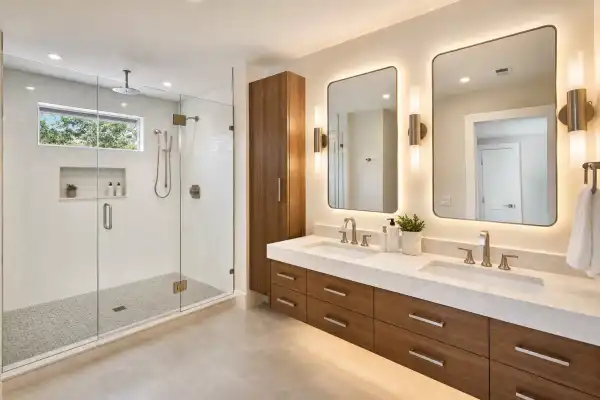
Walk-in shower builds with custom tile and glass enclosures
Tub-to-shower and shower-to-tub conversions
Vanity, mirror, and medicine cabinet installation
Toilet replacement and plumbing upgrades
Heated floor tile and exhaust fan upgrades
Waterproofing membrane installation in wet areas
Why Middletown Homeowners Choose Restoration Control for Bathroom Remodeling
Licensed CT contractor — active state license verifiable online
IICRC-certified technicians with manufacturer-authorized installation training
Free on-site inspection and written estimate with no obligation in Middletown
Full insurance claims support — documentation, Xactimate estimates, adjuster meetings
In-house crews only — no unlicensed subcontractors on your Middletown project
Workmanship warranty backed by a company with 10+ years in Connecticut
24/7 emergency line for storm, water, and fire damage in Middletown
BBB Accredited with A+ rating and 4.9-star average from 250+ reviews
A standard bathroom update (new vanity, toilet, tub surround, and fixtures) ranges from $5,000 to $12,000. A full custom walk-in shower conversion with tile, glass, and plumbing work ranges from $8,000 to $20,000+. We provide detailed written estimates before any work begins.
How do you waterproof a shower?
We use a multi-layer waterproofing system including a pre-sloped shower pan, Schluter KERDI or RedGard membrane applied to all walls and curbs, followed by properly spaced and back-buttered tile with unsanded grout on walls and sanded grout on floors. All penetrations are caulked with 100% silicone.
Can you convert a tub to a walk-in shower?
Yes, tub-to-shower conversions are one of our most popular projects. We remove the existing tub, re-frame the alcove, install a custom shower pan and tile walls, add a frameless or framed glass enclosure, and upgrade the valve, showerhead, and fixtures. The project typically takes 5-7 days.
Request Bathroom Remodeling in Middletown, CT
Call (833) 380-7378 or complete the form below. A licensed CT estimator will contact you within 1 business hour to schedule your free on-site inspection.