Professional Fire Damage Services — Licensed CT Contractor
Fire Damage Restoration in Waterbury
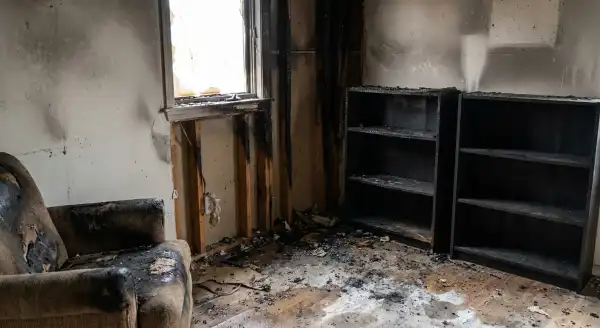
Fire damage restoration in Waterbury reflects the city's industrial-era housing concentration and the heating-season risks that Connecticut's winters create. The South End and Brooklyn have Waterbury's densest multi-family housing — three-story wood-frame buildings from the brass manufacturing era built with balloon-frame construction where continuous wall cavities allow fire to spread from basement to attic with devastating speed. Space heater fires during cold winters are a significant ignition source in Waterbury's older apartments where heating systems are inadequate or tenants supplement heat to reduce utility costs. After fire department suppression, the secondary damage cycle begins immediately: thousands of gallons of suppression water saturate the structure, and in Waterbury's cold winters, this water freezes inside walls and floor assemblies, expanding and causing structural cracking that may equal or exceed the fire damage itself. Smoke from a fire in one unit of a multi-family building migrates through ductwork, wall cavities, and stairwells to contaminate every connected space — a single-unit fire in a Waterbury three-decker typically requires building-wide smoke cleaning and assessment. Our restoration teams begin with structural evaluation and emergency weatherization within hours of fire department clearance, deploying commercial dehumidification to prevent the freeze-damage spiral that winter fires in Waterbury inevitably trigger.
“After a burst pipe flooded our basement during a January freeze, Restoration Control arrived within an hour. Their team was professional, thorough, and kept us informed every step of the way. They handled our insurance claim and had our home restored in under two weeks. We could not have asked for a better experience.”
Robert & Linda M.
Hartford, CT
“A nor'easter ripped shingles off our Shippan Point home and water was pouring into the attic. Restoration Control had a crew on our roof the next morning, tarped the damage, and completed a full replacement within the week. Their knowledge of coastal roofing materials made all the difference.”
Jennifer S.
Stamford, CT
“We hired Restoration Control to replace the original siding on our 1920s Colonial in East Rock. They matched the historic character perfectly while upgrading to fiber cement that will actually withstand Connecticut winters. The craftsmanship is outstanding and the crew was respectful of our neighborhood.”
David & Maria T.
New Haven, CT
“After a kitchen fire, we were devastated. Restoration Control not only restored our home but helped us navigate the insurance process from start to finish. Their fire damage team removed all smoke odor and rebuilt our kitchen better than before. True professionals who treated us like family.”
Thomas K.
Bridgeport, CT
Frequently Asked Questions
Need Fire Damage in Waterbury?
Call now for a free estimate. Our Waterbury team responds within 60–90 minutes, 24 hours a day, 7 days a week.
Fire Damage Restoration in Waterbury, CT — Licensed Contractor
Fire damage restoration in Waterbury reflects the city's industrial-era housing concentration and the heating-season risks that Connecticut's winters create. The South End and Brooklyn have Waterbury's densest multi-family housing — three-story wood-frame buildings from the brass manufacturing era built with balloon-frame construction where continuous wall cavities allow fire to spread from basement to attic with devastating speed. Space heater fires during cold winters are a significant ignition source in Waterbury's older apartments where heating systems are inadequate or tenants supplement heat to reduce utility costs. After fire department suppression, the secondary damage cycle begins immediately: thousands of gallons of suppression water saturate the structure, and in Waterbury's cold winters, this water freezes inside walls and floor assemblies, expanding and causing structural cracking that may equal or exceed the fire damage itself. Smoke from a fire in one unit of a multi-family building migrates through ductwork, wall cavities, and stairwells to contaminate every connected space — a single-unit fire in a Waterbury three-decker typically requires building-wide smoke cleaning and assessment. Our restoration teams begin with structural evaluation and emergency weatherization within hours of fire department clearance, deploying commercial dehumidification to prevent the freeze-damage spiral that winter fires in Waterbury inevitably trigger.
Common Fire Damage Restoration Problems in Waterbury
Balloon-frame fire spread in Waterbury's pre-1940 multi-family buildings is the most dangerous structural fire pattern in the city. The South End and Brooklyn have blocks of three-story buildings where wall cavities run continuously from sill to ridge — fire entering a basement wall cavity reaches the attic before residents on upper floors may be aware of the fire's origin. This construction necessitates full building inspection even when visible fire appears contained to a single unit. Electrical system fires from overloaded vintage wiring are a primary ignition source — many Waterbury buildings retain original knob-and-tube or early Romex wiring on 60-amp service, and the addition of window air conditioners, electric heaters, and modern appliance loads creates chronic overload conditions. Heating equipment fires — malfunctioning furnaces, unattended space heaters, chimney fires from creosote buildup — spike during Waterbury's December-through-March heating season when demand on aging systems is highest. Smoke and soot contamination is the most widespread secondary damage: protein-based smoke from kitchen fires permanently stains surfaces if not cleaned within days, and petroleum-based smoke from structural fires embeds in every porous material. Suppression water damage in Waterbury's multi-story buildings flows downward through floor assemblies, often causing more damage on lower floors than the fire itself caused on the fire floor.
Fire Damage Restoration Regulations in Waterbury, CT
Fire reconstruction in Waterbury requires permits for all structural, electrical, plumbing, and mechanical work through the Building Department. Rebuilt systems must meet current Connecticut Building Code — typically requiring significant upgrades including interconnected smoke and CO detectors in every bedroom and common area, 200-amp electrical service minimum, fire separation between dwelling units to current ratings, and fire alarm systems in buildings with three or more units. Waterbury's fire marshal's office conducts origin-and-cause investigation and must clear the structure before restoration begins. Properties in the Hillside Historic District require Historic Preservation Commission review for exterior reconstruction — replacement materials and architectural details must be compatible with the historic character of contributing structures. Demolition permits are required separately when structural removal is part of the restoration scope. Connecticut requires CT HIC registration for all reconstruction contractors. Lead paint and asbestos testing are mandatory before any demolition or disturbance in pre-1978 buildings — virtually all of Waterbury's fire-prone housing stock. Insurance coordination between property owner, adjuster, and restoration contractor should begin within 24 hours. Multi-family building fires in Waterbury may trigger city building inspection department review of the remaining structure's habitability and code compliance before reoccupancy is permitted.
Fire Damage Restoration by Neighborhood in Waterbury
The South End has Waterbury's highest concentration of fire-prone construction — dense blocks of three-story balloon-frame buildings with aging electrical systems, shared wall cavities between adjacent units, and high occupancy rates. Fire restoration in the South End typically involves multi-unit scope with smoke and water damage extending well beyond the fire's origin unit. Brooklyn mirrors the South End's construction type and fire risk but includes Naugatuck River proximity that adds moisture complexity to post-fire restoration — suppression water combined with high ambient humidity requires aggressive dehumidification to prevent mold establishment during the reconstruction period. Town Plot fire incidents typically involve single-family or small multi-family housing from the 1930s-1950s with less dangerous construction types but still-aging electrical systems — restoration scope is more contained but electrical system upgrade is standard for any significant fire reconstruction. Bunker Hill has similar housing to Town Plot with slightly lower density, reducing multi-structure fire spread risk. Overlook and East Mountain have Waterbury's lowest fire frequency — newer construction with updated electrical, smoke detection, and building code compliance reduces both risk and severity. Downtown Waterbury's mixed-use buildings present commercial fire restoration challenges including larger floor plates, commercial-grade HVAC smoke contamination, and business interruption coordination alongside residential restoration for upper-floor tenants.
Why Waterbury Needs Professional Fire Damage Restoration
Waterbury's fire risk is concentrated in exactly the housing stock least equipped to resist it — pre-1940 multi-family balloon-frame buildings with electrical systems designed for a fraction of modern loads. The city's cold winters add ignition sources (space heaters, overloaded heating systems) and compound fire damage through the suppression-water-to-ice cycle that is unique to cold-climate fires. Professional fire restoration is essential in Waterbury because amateur smoke cleanup drives contamination deeper into porous materials rather than removing it, creating permanent odor and potential health effects from embedded particulate. The economic case for professional restoration is strongest in Waterbury's multi-family buildings where fire damage affects multiple revenue-generating units simultaneously — rapid professional response minimizes tenant displacement and lost rental income. For Waterbury property owners, electrical inspection and panel upgrade is the most cost-effective fire prevention investment available — converting aging 60-amp service to 200-amp with AFCI protection addresses the root cause of the majority of Waterbury's electrical fires. Smoke detector maintenance — monthly testing, annual battery replacement, 10-year unit replacement — is the most basic life-safety investment in a city where balloon-frame construction gives occupants less escape time than modern buildings provide.
What's Included in Our Waterbury Fire Damage Restoration Service
Emergency board-up and roof tarping within hours
Soot and smoke residue removal from all surfaces
Air scrubbing and ozone treatment for odor elimination
Content pack-out, cleaning, and storage
Structural repairs including framing, drywall, and flooring
Final sanitization, painting, and finish restoration
Why Waterbury Homeowners Choose Restoration Control for Fire Damage Restoration
Licensed CT contractor — active state license verifiable online
IICRC-certified technicians with manufacturer-authorized installation training
Free on-site inspection and written estimate with no obligation in Waterbury
Full insurance claims support — documentation, Xactimate estimates, adjuster meetings
In-house crews only — no unlicensed subcontractors on your Waterbury project
Workmanship warranty backed by a company with 10+ years in Connecticut
24/7 emergency line for storm, water, and fire damage in Waterbury
BBB Accredited with A+ rating and 4.9-star average from 250+ reviews
Do not re-enter until the fire marshal has cleared the property. Call your insurance company to report the claim, then call Restoration Control for emergency board-up and tarping to secure the structure. Do not attempt to clean soot or smoke residue yourself — improper cleaning can permanently set stains and embed odors.
Can smoke odor be completely removed?
Yes. We use a combination of HEPA air scrubbers, thermal foggers, hydroxyl generators, and ozone treatment to eliminate smoke odor at the molecular level. All porous materials (insulation, drywall, carpeting) that cannot be adequately cleaned are removed and replaced.
How long does fire damage restoration take?
Minor smoke damage cleanup may take 1-2 weeks. Significant structural fire damage requiring framing, drywall, flooring, and finish work can take 4-12 weeks. We provide a detailed restoration timeline after the initial assessment and coordinate directly with your insurance company throughout the project.
Request Fire Damage Restoration in Waterbury, CT
Call (833) 380-7378 or complete the form below. A licensed CT estimator will contact you within 1 business hour to schedule your free on-site inspection.